Introduction
Search behavior is changing faster than ever before. People are no longer depending only on Google to find answers because AI tools like ChatGPT, Perplexity, and Google AI Overviews now provide direct responses without requiring users to click multiple websites.
This shift is creating a major problem for businesses and SEO professionals because visibility is no longer guaranteed through traditional rankings. A website can rank on page one of Google but still fail to appear in AI-generated answers.
This gap between Google SEO and AI visibility has created a new category of optimization known as AI Search Analytics. One of the most advanced tools in this space is Ziptie AI Search Analytics, which focuses on tracking how brands appear inside AI-generated responses.
It helps businesses understand whether AI systems mention their brand, how often they are cited, and how they compare against competitors inside AI answers. This makes it a powerful tool for modern SEO strategy.
AI Overview Section
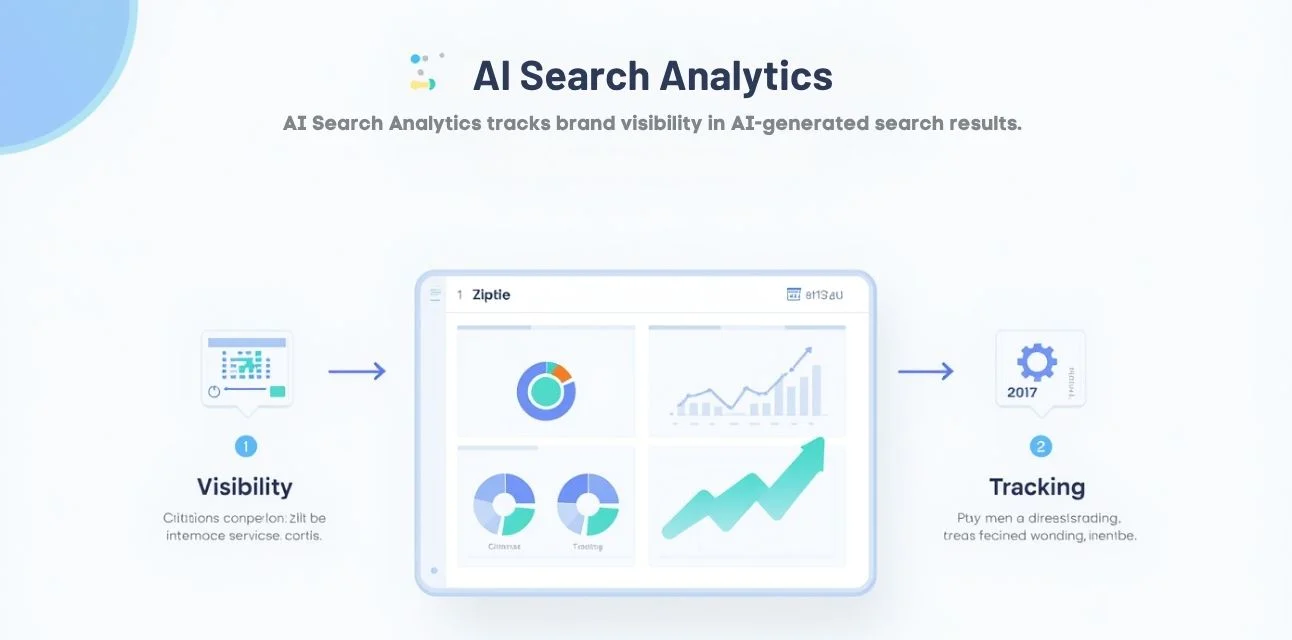
Ziptie AI Search Analytics is a system that tracks how brands appear inside AI-generated search results across platforms like ChatGPT, Google AI Overviews, and Perplexity. It measures visibility, mentions, and citations to show whether AI systems are recommending or ignoring a brand.
In simple terms, it helps businesses understand how AI “sees” their content and whether they are part of AI-generated answers when users ask questions online.
Key Points About Ziptie AI Search Analytics
- It tracks brand mentions inside AI responses across multiple platforms
- It measures how often content is used as a source or citation
- It compares your visibility with competitors in the same niche
- It calculates AI share of voice based on response frequency
- It helps improve content strategy for AI-driven search systems
What is Ziptie AI Search Analytics?
Ziptie AI Search Analytics is a modern SEO intelligence tool designed specifically for the AI search era. Unlike traditional SEO tools that focus on keyword rankings, this tool focuses on whether AI systems include your brand in generated answers.
It works by analyzing AI-generated responses and identifying patterns in how often a brand appears, how it is described, and whether it is used as a trusted source.
This makes it extremely useful for businesses that want to understand their visibility in AI-powered search environments rather than just Google search results.
The main idea behind Ziptie is simple. If AI is becoming the new search engine, then brands need to know how AI is presenting them to users.
To understand the complete ecosystem of AI search tracking, you can explore the full guide here
👉 Ziptie AI Search Analytics Complete Guide https://techyquant.com/ziptie-ai-guide/
How Ziptie AI Search Analytics Works
Ziptie works through a structured process that simulates real user behavior in AI search systems and then analyzes the responses in detail.
The process starts by generating search queries that reflect real user intent such as product comparisons, informational questions, and problem-solving prompts. These queries are sent to AI systems like ChatGPT and Google AI Overviews.
The system then collects AI-generated responses and stores them for analysis. Each response is scanned to detect brand mentions, competitor references, and content citations.
After collecting this data, Ziptie converts it into structured insights such as visibility score, mention frequency, and share of voice. These metrics help businesses understand their AI search performance clearly.
This entire process allows marketers to see how AI systems interpret and present their brand in real-time search scenarios.
Core Features of Ziptie AI Search Analytics
Ziptie offers several advanced features that are designed to give deep insights into AI-driven search visibility.
One of the most important features is AI mention tracking, which monitors how often a brand appears in AI-generated answers. This helps businesses understand whether they are part of AI conversations or completely missing from them.
Another key feature is citation tracking, which identifies when AI systems use a website as a trusted source. This is important because AI models prefer authoritative and well-structured content when selecting references.
The platform also includes competitor analysis tools that allow users to compare their AI visibility with other brands in the same industry. This helps identify which competitors are dominating AI search results.
Additionally, sentiment analysis helps determine how AI describes a brand, whether positively, neutrally, or negatively, which is important for reputation management.
Why Ziptie AI Search Analytics Matters
AI search is becoming a major part of how users discover information online. Instead of browsing multiple websites, users now rely on AI-generated answers that provide direct and summarized information.
This creates a major challenge for businesses because traditional SEO strategies are not enough to guarantee visibility in AI responses.
From real SEO observation, it is clear that AI visibility does not always match Google rankings. Some high-ranking websites are completely missing from AI responses, while lower-ranked pages appear frequently.
This happens because AI systems prioritize clarity, structure, and contextual relevance rather than just backlinks or domain authority.
Ziptie helps solve this problem by showing exactly how AI systems view and include your brand in their responses. This makes it a crucial tool for modern digital marketing strategies.
Simple Comparison Table
| Factor | Traditional SEO | AI Search Analytics |
| Focus | Keyword ranking | AI visibility |
| Platform | ChatGPT, AI Overviews | |
| Output | SERP position | AI answer inclusion |
| Metric | Traffic clicks | Brand mentions |
| Strategy | Backlinks + SEO | Content + authority signals |
Step-by-Step Use of Ziptie AI Search Analytics
- Step 1: Select Keywords or Prompts
Start by choosing relevant keywords or search questions from your industry. These can include product searches, informational queries, or competitor comparison terms that users actually type. - Step 2: Run AI Searches
Enter these queries into AI platforms like ChatGPT, Perplexity, or Google AI Overviews to collect real AI-generated answers based on those questions. - Step 3: Collect and Review Responses
Gather the AI responses and carefully check them to see how different brands are being mentioned or recommended. - Step 4: Analyze Mentions and Citations
Identify where your brand appears, how often it is mentioned, and whether AI is using your content as a source or referencing competitors. - Step 5: Generate Performance Reports
The system organizes all findings into structured reports that show visibility trends, share of voice, and comparison with competitors. - Step 6: Improve Content Strategy
Use these insights to optimize your content, making it more structured and AI-friendly so your brand appears more often in AI-generated answers.
Here is a simple flow of how Ziptie AI Search Analytics works:
User Query
↓
AI System (ChatGPT / Google AI / Perplexity)
↓
AI Generates Answer
↓
Ziptie Tracks Response
↓
Detects Brand Mentions + Citations
↓
Creates Visibility Score & Report
Practical Insights from AI Search Behavior
From real SEO testing, AI systems often behave differently than expected.
Some brands with lower authority still appear in AI answers because their content is more structured and direct.
Other high-authority websites are skipped because their content is not AI-friendly or clearly formatted.
Key Observations:
- Clear content improves AI citation chances
- Structured answers perform better in AI search
- Authority alone is not enough anymore
Common Mistakes and Misconceptions
- Assuming high Google rankings automatically guarantee AI visibility. This is not true because AI systems use different ranking logic and focus more on context, relevance, and clarity when generating answers.
- Thinking backlinks alone decide AI search performance. While backlinks still help, AI tools often prioritize well-structured, easy-to-understand, and directly useful content over link quantity.
- Ignoring AI search optimization and relying only on traditional SEO. This creates a visibility gap as more users are now getting answers directly from AI platforms instead of search engines.
- Not optimizing content for natural language queries. AI systems prefer conversational, question-based content, so pages that lack clear answers may be skipped.
- Overlooking content clarity and structure. Even strong content may not appear in AI answers if it is not organized in a simple and readable format.
FAQs
Ziptie AI Search Analytics is used to track how often a brand appears in AI-generated search results. It helps businesses understand their visibility in AI platforms and compare it with competitors to improve digital presence.
Ziptie focuses on AI-generated search visibility instead of traditional keyword rankings. SEO tools track Google positions, while Ziptie tracks how AI systems mention or recommend brands in responses.
SEO professionals, marketers, SaaS companies, and content creators should use it. It is especially useful for businesses that want to improve visibility in AI-driven search environments.
No, it does not directly improve Google rankings. However, it helps improve content quality and structure, which can indirectly support better SEO performance.
AI search is becoming a major way users find information. If a brand is not included in AI responses, it loses visibility opportunities even if it ranks well on Google.
Yes, it compares your brand visibility with competitors and shows who dominates AI-generated answers in your industry.
Conclusion
Ziptie AI Search Analytics represents a major shift in how SEO and digital visibility are measured. It focuses on AI-generated search results rather than traditional keyword rankings, making it highly relevant for the future of search.
As AI tools become more widely used, understanding how your brand appears in AI responses will become just as important as Google rankings.
Businesses that adapt early to AI search analytics will have a strong advantage in visibility, authority, and digital presence.
The key takeaway is simple. SEO is no longer just about search engines. It is now about how AI systems understand, interpret, and present your brand to users.